In my video on the Concave I told you to go try and find the Prosolvia King Tut demo, and that you couldn’t. Not in the trade press, not in the web archives [1]. I was wrong. I found it on the Internet Archive, along with a few other demos from that era. The King Tut one still runs, and below you can watch it fly the same camera path as a 2026 render of Factum Foundation’s 2009 scan of the same room.
I have been doing 3D since 1998. I started under Prosolvia, the Swedish VR software company, at their office in Troy, Michigan, and the showpiece I remember best from that year is King Tut. In May 1998 the Mysteries of Egypt exhibition opened at the Canadian Museum of Civilization in Hull, Quebec, and one of its big draws was a 3D virtual reality theatre that took visitors on a tour of Tutankhamun’s burial chamber [2][3]. Prosolvia provided the engine. A live guide flew the room on an SGI Onyx2 running our Oxygen software, 25 people at a time, carrying a digital flashlight that threw real shadows across the sarcophagus. I tell the whole story in my video on the Concave [1].
That room followed me. Prosolvia went bankrupt at the end of 1998 [4]. Its founders bought the PC version of the engine back from the bankruptcy trustees and started over in Irvine, California as EON Reality [1][5], and I moved out there with them. In 1999 we ported the King Tut tour off the Onyx2 and onto Windows PCs to run on the Concave, the three-PC curved stereo screen we built, and squeezed the polygon budgets until it fit [1]. The copy I found is EON’s web build of the demo, one 1.1 MB file saved on September 18, 2001, and it still runs in EON Viewer on a PC today.
This year I rebuilt the same room from the best data there is now: Factum Foundation’s 2009 high resolution recording of the burial chamber [6][7]. Then I made the old demo fly the exact same camera path, so the two sit on top of each other frame for frame. Drag the line across the video to wipe between them.
Left of the line: the 1998 King Tut tour as it survives in EON Reality’s 2001 web build, captured from EON Viewer. Right of the line: the same camera path rendered in Blender from Factum’s wall data. 45 seconds, 1080p, no sound. The button at the bottom switches to a plain side by side.
How I found it, and why there aren’t more
I found it digging deep in the Internet Archive. Most of these demos survive as a single working copy, if they survive at all. A lot of the links I chased handed back the Wayback Machine’s own web page saved under the demo’s file name, or an empty file.
There is a bigger reason the trail goes cold. When EON moved to its 3D streaming format, the geometry was locked away by design. The file you downloaded was a small stub, and the stub pulled the actual models from EON’s servers as you moved through the scene. Those servers are long gone, so an archived stub is an empty shell. It is the same problem as games that need server-side data: when the servers go dark, the game goes with them. The format evolved, the data stayed under control, and preservation lost. Controlling the data and preserving it often butt heads, and this is what that looks like.
The King Tut file is from before that change. Every mesh and texture is inside the one 1.1 MB file, which is why it still runs. I’m happy to have found what I did.
What you are looking at
1998: drawn walls, a scanned mask
There is a second thing my video got wrong. In it I said the National Research Council of Canada laser scanned the burial chamber for this tour. NRC’s own researchers wrote the project up in 2004, and they say the room was not imaged at the site. The 3D model was built in ArchiCAD from survey data supplied by the Theban Mapping Project, and the paintings were mapped onto it from detailed color slides the Getty Conservation Institute shot during a 1992 conservation survey. Egypt’s Supreme Council of Antiquities gave permission to use both [3]. The thing that did get scanned was the mask. A replica of Tutankhamun’s gold mask was scanned at the museum with a commercial 3D scanner and placed in the sarcophagus [3]. The paper is a better source than my memory, so I’ve gone with the paper.
It still landed. The Globe and Mail called the VR tour the major innovation in the exhibition, and in the museum’s visitor survey 86 percent of respondents got the point of it: VR lets you visit a site without doing it any more damage [3]. Not everyone was sold. A representative of the Supreme Council of Antiquities said the walls were flat, like a normal office building [3]. Look at the left side of the video and you can see exactly what that meant.
What survived: EON’s 2001 web build
The web build is that same tour after two diets. The original on the Onyx2 ran into the hundreds of megabytes, mostly big high resolution textures and 44.1 kHz narration. For the Concave I got the narration down from nearly 70 MB to about 15 by switching to a new thing called MP3 [1]. The web build goes further. It is a single .eoz file, a ZIP holding the scene, 69 meshes and 31 JPEG textures, 1.1 MB in all, and the narration is gone. The room is 6,188 triangles of flat wall. The gold mask is 20,152 triangles with one 1024 by 1024 texture. Every painting is squeezed into a texture no bigger than 1024 by 512 pixels, and the north wall, the big one with Ay and Osiris, gets exactly one of those. All 31 textures together come to 3.7 megapixels and 597 KB.
EON kept coming back to this tomb. In 2010 they put a touchscreen version of the burial chamber into the Las Vegas Natural History Museum [10].
2009: Factum Foundation’s scan
In spring 2009 a four-person Factum Arte team spent a month recording the burial chamber. They captured the wall surfaces in 3D with the Lucida scanner and white light scanning at 200 to 700 microns, and photographed the color at 600 to 800 dpi from computer-controlled rigs that held a Canon EOS 5D Mark II at a fixed distance from the wall. That came to more than 16,000 photographs and about 300 GB [6]. Factum describes the recording as “essential to monitor the level of decay and rate of change” [6]. The same data went into an exact facsimile of the chamber, which is on permanent display in the Valley of the Kings [8] and opened on April 30, 2014 [9].
Factum also put the walls online in a deep-zoom viewer [7]. Its files for the north wall add up to 89,840 by 52,360 pixels for a wall 6.52 by 3.80 meters, which works out to 350 dpi at actual size. The viewer carries the line “© Ministry of Antiquities, Egypt. 2020”. I used the zoom level one step down from the top, 22,528 pixels across for the north wall, scaled to 75 percent for the render. That is still about 2,600 pixels for every meter of wall.
The numbers
| 1998 tour (2001 web build) | Factum data (2009 recording) | 2026 render | |
|---|---|---|---|
| North wall image | 1024 x 512 px | 89,840 x 52,360 px | 16,896 x 9,847 px |
| Detail across the north wall | 160 px per meter | 13,780 px per meter | 2,591 px per meter |
| Where the wall color came from | color slides from a 1992 conservation survey [3] | more than 16,000 photographs at 600 to 800 dpi | Factum’s viewer files |
| Room geometry | 6,188 triangles of flat wall, CAD model from survey data [3] | 3D surface scans at 200 to 700 microns | box room built to Factum’s measured wall sizes |
| Gold mask | 20,152 triangles, one 1024 x 1024 texture; the 1998 mask came from a 3D scan of a replica [3] | not part of the wall data | 500,000 triangles, three 4096 x 4096 maps (AI-generated model) |
| Size of the data | 1.1 MB for everything | about 300 GB of photographs | 179 MB of viewer tiles, one zoom level, four walls |
| Time per frame | real time | n/a | 7.3 s (walls) to 11.9 s (mask) per 4K frame |
On the north wall that is 86 times the detail in each direction between the web build’s texture and the full Factum data, and close to 9,000 times as many pixels for the same patch of plaster. Even the cut-down version I rendered from is 16 times sharper in each direction. To be fair to 1998, the theatre in Hull ran much bigger textures than this web build, so the gap in that room was smaller. The web build is the version that survived, so it is the one I can measure.
Up close
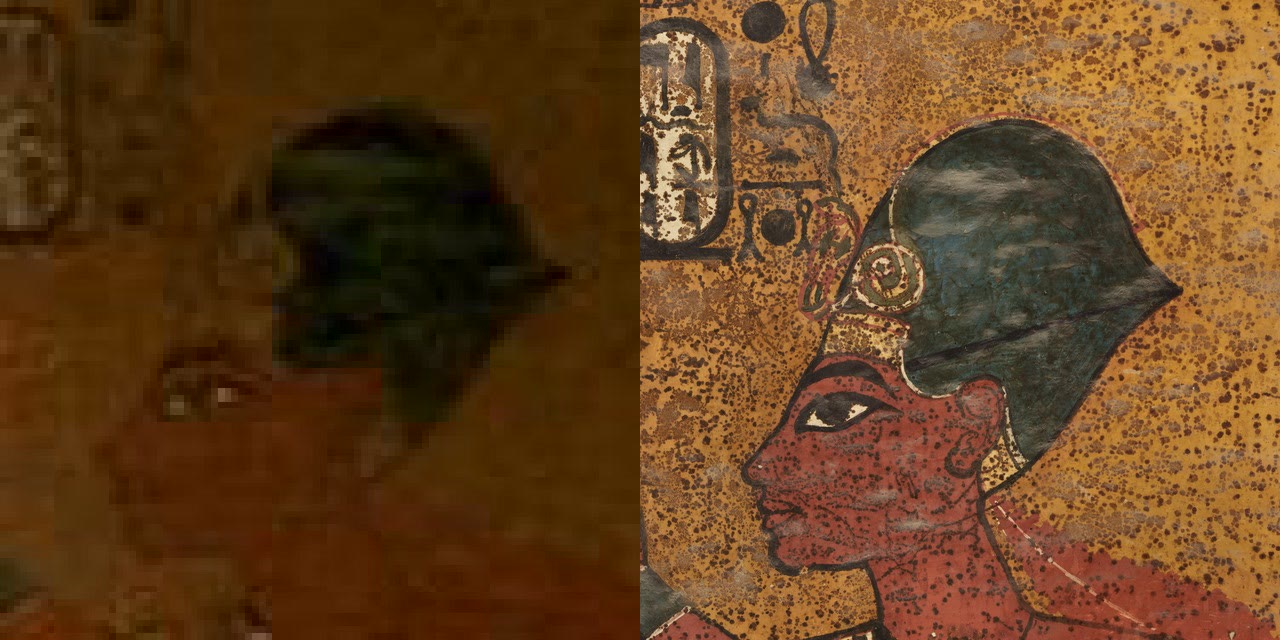
This is the one that got me. In the web build the crown is about 75 pixels across. In the Factum files it is over 1,300, and the top zoom level doubles that again. You can see the brush work in the band around the crown, the cracks, and every one of the dark spots that cover these walls.
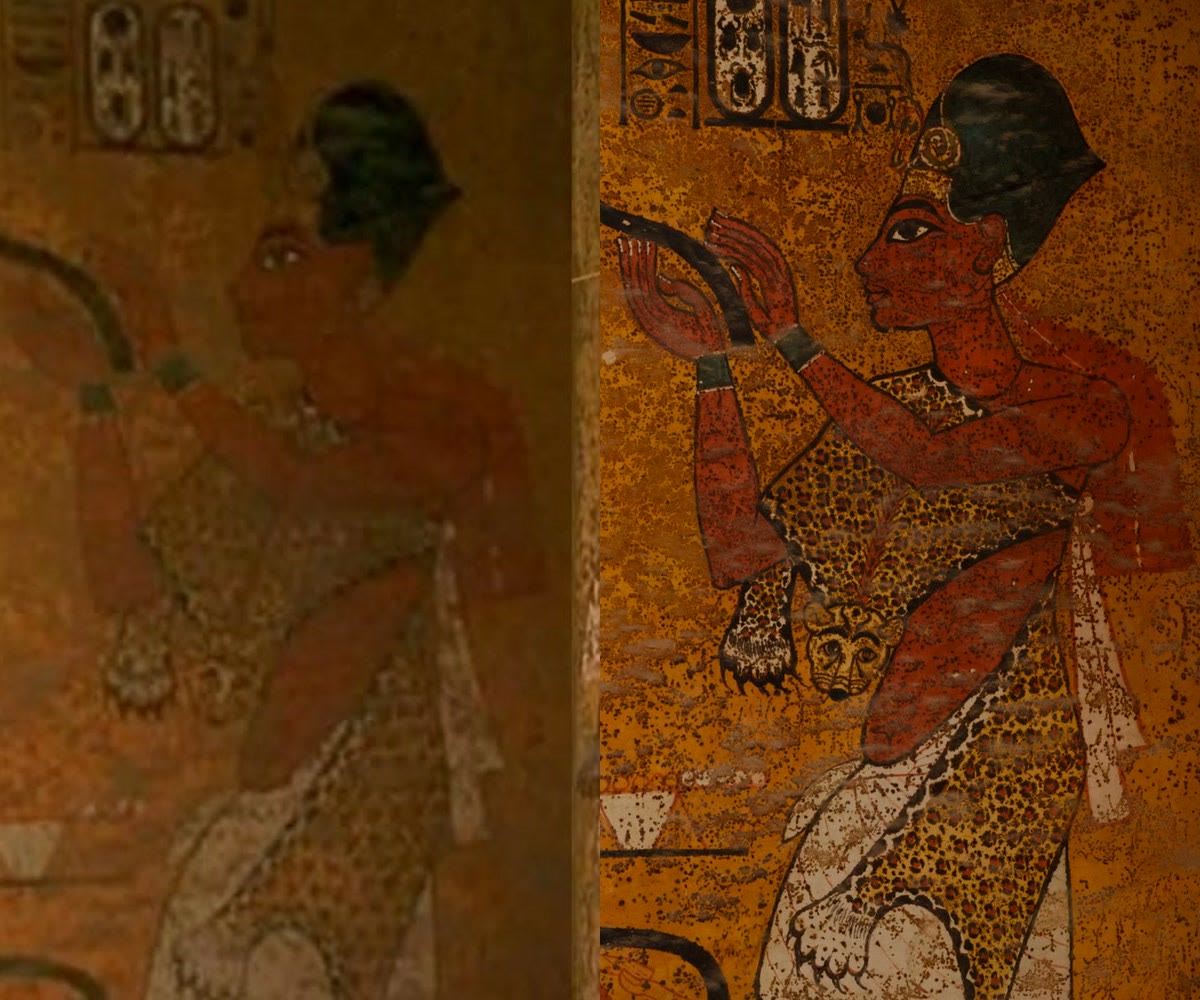
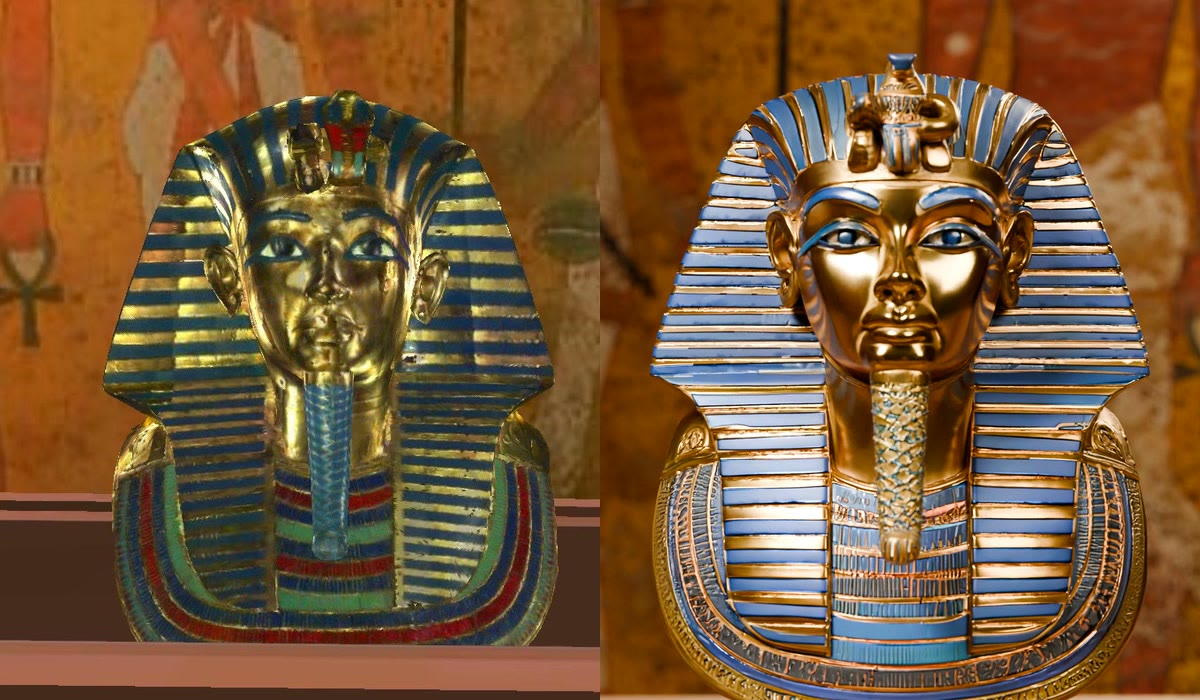
The mask flips the whole comparison. On the walls, 1998 is the drawing and 2009 is the measurement. On the mask it runs the other way. The 1998 mask came from a 3D scan of a museum replica [3], and the 20,152 triangle mask in the web build holds up better than I expected. That is the mask that floated off the Concave screen in 1999 while grown adults reached out to touch it [1]. The mask in my render is a 500,000 triangle model by Roberto Domínguez, made with Tencent’s Hunyuan3D generator and shared on Sketchfab under CC BY 4.0 [12][13]. It looks great at 4K, but it is an AI reconstruction, not a measurement of anything, so treat the fine detail as a very good guess. The real one is 54 cm tall and over 10 kg of gold, inlaid with lapis lazuli, quartz, obsidian, carnelian and colored glass [14].
How the two were lined up
Getting a demo saved in 2001 to follow a 2026 camera path took more than a screen recording. EON Viewer only moves its camera through a handful of preset views tied to keys. So I patched the demo file itself: the camera’s start position, its field of view and the targets of its preset moves, all edited in place inside the .eon scene. Each launch of EON Viewer flew five short legs of the path, I recorded six launches, and each of the 1,350 frames in the final video is the recorded frame whose camera position is closest to the Blender camera at that moment. Lens changes are done with a center crop, which for a pinhole camera gives the same picture as a longer lens. The demo spins its mask the other way, so that stretch plays in reverse.
The rooms will never match perfectly because they were never the same room. The web build’s chamber is about 6.4 by 4.1 by 3.65 meters, and Factum’s measured walls make it 6.52 by 4.19 by 3.80 [7]. I mapped one onto the other wall to wall. The demo also raises its mask from lying flat, the same way it always did.
What I take from it
In 1998 a guide with a digital flashlight walked 25 people at a time into a room that visitors to the real tomb could not enter [1][3]. The walls were survey drawings wearing photographs of the paintings, and the whole thing ran live on a computer the size of a refrigerator. Eleven years later Factum spent a month in the chamber with scanners and cameras and recorded the actual surface, every crack and every one of those dark spots, because those walls are changing [6]. Run the two through the same camera and you can see exactly what that jump buys you.
I got to be in the room for the first one. Twenty-eight years later I got to put it next to the second. That never stops being cool.
Help me find the rest
If you have one of the old EON demo CDs that used to ship with the software, or a full copy of any EON demo from that era, I want to hear from you. Full copies, with the geometry inside, not the small stub files that point at servers that no longer exist. Tell me in the comments on the video.
And if you worked on the Mysteries of Egypt theatre, at the Canadian Museum of Civilization, NRC, Prosolvia or EON Reality, and you remember it differently, tell me that too and I will correct it here. I was one of the people who built this, so treat me as a primary source with all the problems that implies. A follow-up video with all of this, and the other demos I found, is coming soon.
Credits and sources
The 1998 tour was built for the Canadian Museum of Civilization with the National Research Council of Canada and partners, from Theban Mapping Project survey data and Getty Conservation Institute slides [2][3], running on Prosolvia’s engine. The web build is © EON Reality and was captured from EON Viewer. Wall imagery from Factum Foundation’s recording of the burial chamber, © Ministry of Antiquities, Egypt. Mask model: “Tutankhamun mask – Hunyuan” by Roberto Domínguez (@vmmaniac), licensed CC BY 4.0. Rendered in Blender (Cycles). Room, lighting, camera and the comparison by me.
- TheRND2, I Helped Destroy the Million-Dollar Supercomputer (With Three PCs) (2026), with its companion post; my first-hand account of Prosolvia, EON Reality and the Concave
- J. M. Taylor, G. F. MacDonald, M. Rioux, F. Corcoran and P. Boulanger, CMC’s 3-D Virtual Reality Theatre: VR Tours of Two Tombs during the Mysteries of Egypt Exhibition, ICHIM99
- J. M. Taylor, J.-A. Beraldin, M. Picard, S. F. El-Hakim, G. Godin, V. Valzano and A. Bandiera, Applications of High-Resolution 3D Imaging to the Recording and Conservation of Ancient Crypt and Grotto Sites, 2nd International Conference on the Conservation of Grotto Sites, Dunhuang, 2004
- Realtid, Gigantiskt skadestånd avgörs (October 15, 2010, in Swedish), on the 1998 Prosolvia bankruptcy and the court cases that followed
- Wikipedia, EON Reality
- Factum Foundation, Recording the burial chamber of Tutankhamun in high resolution
- Factum Arte, Tutankhamun tomb high-resolution viewer; wall sizes, pixel sizes, 350 dpi and the copyright line come from the viewer’s own metadata for the north, east, south and west walls
- Factum Foundation, The authorized facsimile of the tomb of Tutankhamun
- NBC News, Replica King Tut Tomb Unveiled in Egypt (2014)
- EON Reality, King Tutankhamun comes alive at the Las Vegas Natural History Museum (March 17, 2010)
- Wikipedia, Tomb of Tutankhamun
- Sketchfab, Tutankhamun mask – Hunyuan by Roberto Domínguez
- Tencent Hunyuan, Hunyuan3D 2.0
- Wikipedia, Mask of Tutankhamun